Off-Road Air Compressors and Tire Deflators: The Tire Pressure Upgrade Every Rig Needs
Airing down can improve traction, comfort, and control off-road, but you need a reliable way to manage tire pressure before and after the trail. Learn how tire deflators, portable compressors, onboard air systems, and proper PSI can make your truck, Jeep, SUV, or UTV more capable.
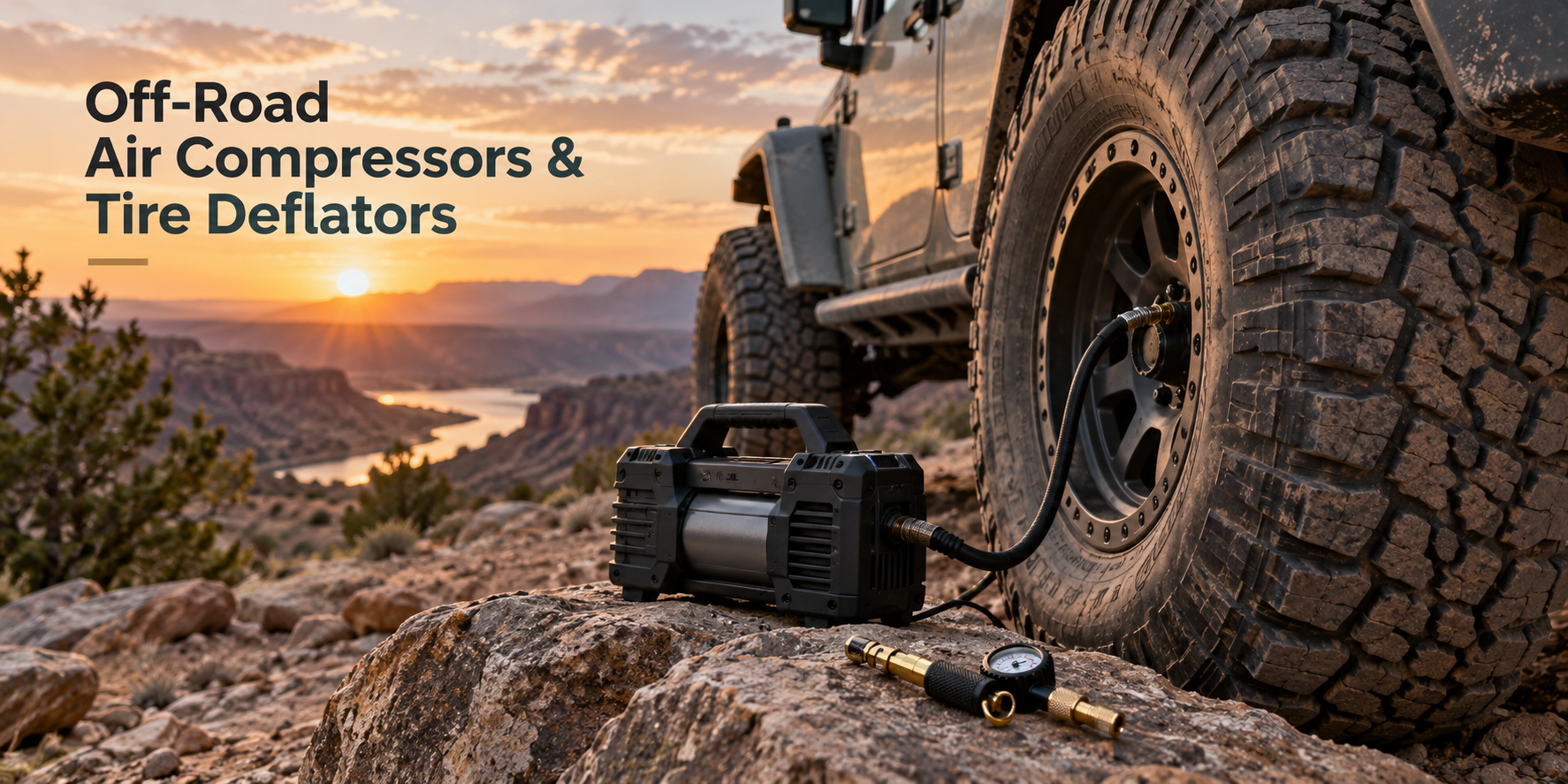
Some of the most useful off-road upgrades never change how your vehicle looks.
Tire pressure management is one of them.
Lowering tire pressure before leaving pavement can improve traction, ride comfort, and control on rocks, sand, dirt, snow, and rough trails. But once the trail ends, those tires need to return to an appropriate road pressure before highway driving.
That makes a tire deflator and reliable air compressor one of the most practical combinations you can carry in a truck, Jeep, SUV, overland rig, or side-by-side.
Whether you use a compact portable compressor or a permanently mounted onboard air system, the goal is the same: control tire pressure instead of letting the terrain decide it for you.
Why Does Tire Pressure Matter Off-Road?
Tire pressure affects the shape of the tire, the size of its contact patch, and how easily the tire can conform to uneven terrain.
At normal street pressure, a tire is relatively firm. That works well on pavement, where stability, steering response, tread wear, and heat management matter.
Off-road conditions are different.
Reducing pressure allows the tire to flex more. That can help more of the tread stay in contact with rocks, loose dirt, sand, snow, and other uneven surfaces.
More Traction
A larger, more flexible contact patch can help the tire find grip where a tire at full street pressure may bounce, spin, or dig.
This is especially noticeable on rocks and soft surfaces where the tire needs to conform to the terrain rather than simply roll across it.
A Smoother Ride
Airing down can also make rough roads significantly more comfortable.
The tire becomes part of the suspension system, absorbing some of the sharp impacts from rocks, washboard roads, roots, and trail debris before they reach the chassis.
Better Control
A tire that stays in contact with the terrain can provide more predictable traction than one that constantly skips or bounces across the surface.
That can make technical sections feel more controlled at appropriate off-road speeds.
What Does Airing Down Mean?
Airing down simply means reducing tire pressure before driving off-road.
The objective is not to make the tire as soft as possible. It is to find a pressure that provides useful tire flex while still protecting the tire, wheel, and bead.
The right pressure varies considerably from one vehicle to another.
Vehicle Weight Matters
A lightweight side-by-side and a fully loaded overland truck should not automatically run the same PSI.
Vehicle weight, cargo, tire construction, wheel size, tire size, and suspension setup all affect how much pressure is appropriate.
Tire Construction Matters
Different tires have different sidewall stiffness, load ratings, and construction.
A heavy-duty truck tire may require different pressures than a lighter all-terrain tire even when the overall tire dimensions are similar.
Wheel Setup Matters
Beadlock and non-beadlock wheels also change how aggressively a driver may be able to lower pressure.
Running extremely low pressure on a conventional wheel increases the risk of unseating the tire bead. Lower pressure can also expose the wheel and sidewall to additional damage.
How Does Terrain Change Tire Pressure?
There is no single off-road PSI that works perfectly everywhere. Different terrain places different demands on the tire.
Sand and Dunes
Soft sand rewards flotation.
Reducing tire pressure increases the size of the tire's footprint, helping the vehicle stay closer to the surface instead of digging downward.
This is one reason airing down is such an important part of sand and dune driving.
Rocks and Technical Trails
On rocky terrain, a more flexible tire can wrap around uneven surfaces and maintain better contact.
Lower pressure can also reduce some of the bouncing that occurs when a firm tire strikes rocks and ledges.
Good tire pressure does not replace careful line choice, lockers, suspension, or driver technique, but it can help those systems work more effectively.
Washboard and Dirt Roads
Long stretches of washboard road can be punishing at full street pressure.
Airing down moderately allows the tire to absorb more of the small, repetitive impacts and can make the vehicle feel less harsh and unsettled.
This is especially useful for overland vehicles that may spend hours on unpaved roads without encountering extreme obstacles.
Mud and Snow
Pressure changes can also help in mud and snow, but tread design and conditions become especially important.
In some situations, a larger footprint improves traction and flotation. In others, a tire may need to dig through a loose surface to reach firmer ground beneath it.
Tire pressure should be treated as one part of the overall traction strategy rather than a universal solution.
What Do Tire Deflators Do?
You can technically air down a tire by pressing the valve stem manually, but doing four tires that way is slow and inconsistent.
Tire deflators make the process faster and easier to control.
Manual Tire Deflators
A manual deflator allows the driver to release air while monitoring tire pressure with a gauge.
This gives you much more control than repeatedly pressing a valve stem and checking pressure afterward.
Automatic Tire Deflators
Some deflators can be preset to a target pressure. They attach to the valve stems and release air until the tire reaches approximately the selected PSI.
This can make preparing four tires for the trail faster and more consistent.
Valve-Core Deflators
Another style temporarily removes the valve core to release air more quickly.
These can make airing down large tires significantly faster, but the user needs to reinstall the valve core correctly and monitor pressure carefully.
Why Do You Need an Off-Road Air Compressor?
Airing down only works as part of a complete system if you can air the tires back up afterward.
Driving highway speeds on significantly reduced tire pressure can create excessive heat, poor handling, sidewall stress, increased wear, and reduced stability.
An off-road air compressor lets you restore tire pressure before returning to normal road driving.
Portable Air Compressors
Portable compressors are a straightforward solution for most recreational off-road drivers.
They can be stored with recovery equipment and connected when needed. Depending on the compressor, power may come directly from the vehicle battery or another appropriate electrical connection.
A portable system also has the advantage of being transferable between vehicles.
Onboard Air Systems
Drivers who air down frequently may prefer a permanently mounted onboard compressor.
An onboard system keeps the compressor installed and ready to use. Depending on the configuration, it can support tire inflation, air tools, air tanks, or air-operated accessories.
Some off-road builds also use onboard air to operate selectable locking differentials. ARB, for example, is well known in the off-road market for air-operated locker and compressor systems.
Single vs. Dual Compressors
More compressor capacity generally means faster inflation, particularly with large-volume off-road tires.
A single compressor may work perfectly well for occasional trail use or moderate tire sizes. Drivers running very large tires or airing up frequently may benefit from a higher-output or dual-compressor system.
The right choice depends more on tire volume and intended use than on maximum pressure alone.
How Do You Choose the Right Air Compressor?
Air compressor specifications can look impressive on a product page, but a few characteristics matter more than others for off-road use.
Airflow
Large off-road tires contain a lot of air.
A compressor that works quickly on a passenger-car tire may feel painfully slow when filling four 35-inch or 37-inch tires after a trail ride.
Look at airflow and real-world inflation performance, not just the maximum PSI printed on the box.
Duty Cycle
Duty cycle describes how long a compressor can operate within a given period before it needs time to cool.
This matters because filling four large tires can require several minutes of continuous operation.
A compressor designed only for occasional emergency inflation may overheat or require cooldown periods during a complete four-tire air-up.
Power Requirements
Higher-output compressors often require more electrical current.
Many serious portable compressors connect directly to the vehicle battery rather than relying on a standard accessory outlet.
Always follow the manufacturer's wiring, fuse, and power requirements.
Hose Length and Gauge Quality
A compressor is much easier to use when the hose comfortably reaches every tire.
A clear and accurate pressure gauge also makes it easier to return all four tires to a consistent road pressure.
Small details such as quality fittings, chucks, hoses, and storage can make a major difference in how convenient the system is on the trail.
What Other Tire Gear Should You Carry?
A compressor solves the air problem, but it does not solve every tire problem.
A proper trail kit should prepare you for pressure changes and common punctures.
Tire Repair Kit
A quality plug kit can repair many tread-area punctures well enough to get a vehicle moving again.
After repairing the puncture, the air compressor becomes essential for restoring lost pressure.
Pressure Gauge
Do not rely entirely on a vehicle's tire-pressure monitoring system when adjusting trail pressure.
A dedicated gauge makes it easier to check each tire directly and make small adjustments.
Valve Tools and Spare Valve Cores
Valve cores are tiny parts with an impressive ability to ruin a trail day when one becomes damaged or disappears.
A valve-core tool and a few spare cores take almost no space and are worth carrying.
Full-Size Spare
Not every tire can be repaired with a plug.
Sidewall damage, major cuts, wheel damage, or a tire that comes off the bead may require a spare tire or more extensive recovery.
For remote off-road travel, a properly sized spare remains one of the best forms of insurance.
Should You Consider a Four-Tire Inflation System?
Drivers who air down regularly may want to go beyond a basic compressor hose.
Multi-tire inflation systems connect several tires to one air source so pressure can be adjusted together.
More Consistent Pressure
Connecting tires together can help equalize pressure between them, reducing the amount of time spent moving a gauge from tire to tire.
Faster Trail Transitions
A well-designed multi-tire system can make airing down before a trail and airing up afterward much more convenient.
That convenience becomes more valuable for drivers who go off-road frequently.
Not Necessary for Everyone
A four-tire system is useful, but it is not required to manage tire pressure properly.
A reliable compressor, accurate gauge, and good deflators can handle the same job one tire at a time.
Do UTVs and Side-by-Sides Need Air Compressors Too?
Tire pressure is just as important on UTVs and side-by-sides as it is on full-size trucks.
Small changes in PSI can noticeably affect traction, steering feel, ride quality, and tire behavior on lightweight machines.
Compact Gear Makes Sense
Storage space is more limited on most side-by-sides, so compact air compressors and repair kits are especially useful.
The goal is to carry enough equipment to handle a tire problem without filling every available storage compartment.
Low Tire Pressure Makes Accuracy Important
Because many UTV tires operate at relatively low pressure, even a small PSI change can represent a meaningful difference.
A gauge designed to read accurately in the relevant pressure range is particularly useful.
What Are the Most Common Tire Pressure Mistakes?
Tire pressure management is relatively simple, but several common mistakes can create unnecessary problems.
Airing Down Too Far
Lower is not always better.
Excessively low pressure can increase the risk of losing the tire bead, damaging the wheel, cutting a sidewall, or making the vehicle feel unstable.
Forgetting to Air Back Up
Trail pressure and highway pressure serve different purposes.
Before returning to sustained road speeds, tires should be returned to an appropriate pressure for the vehicle, load, tire, and road conditions.
Buying Too Little Compressor
A tiny emergency inflator may technically reach the required PSI but still take an unreasonable amount of time to fill four large off-road tires.
Choose a compressor based on the amount of air you actually need to move.
Using the Same PSI Everywhere
The pressure that works well on a rocky trail may not be ideal for sand, high-speed dirt, snow, or a heavily loaded overland trip.
Learning how your vehicle responds to pressure changes is more useful than searching for one universal number.
Ignoring Tire Temperature
Tire pressure changes as temperature changes.
Pressure measured after extended driving may differ from pressure measured when the tires are cold. Keep that in mind when making adjustments during a trip.
Who Should Carry a Compressor and Tire Deflators?
For most people who intentionally drive off pavement, an air compressor and tire deflators are useful additions to the recovery kit.
They are especially valuable for:
- Jeep and 4x4 trail builds
- Overland trucks and SUVs
- Rock-crawling vehicles
- Sand and dune vehicles
- UTVs and side-by-sides
- Vehicles running larger off-road tires
- Drivers who regularly travel on rough dirt roads
- Remote or backcountry travel
Unlike many performance upgrades, an air system does not require an extreme build to be useful. Even a mostly stock truck on quality all-terrain tires can benefit from being able to adjust pressure for changing terrain.
Make Tire Pressure Part of Your Trail Setup
Tires are one of the most important parts of any off-road vehicle, and pressure determines how those tires interact with the terrain.
Airing down can improve traction, comfort, and control. Tire deflators make that process faster and more consistent. A properly sized air compressor lets you return to road pressure when the trail ends.
Together, they create one of the simplest and most useful systems you can add to an off-road build.
The best setup is not necessarily the biggest compressor or the lowest tire pressure. It is the setup that matches your vehicle, tire size, terrain, and the way you actually use the rig.
Building your trail kit? Explore off-road parts and accessories at Elite Offroad.